In this analysis
The moment a suggestion becomes an action
A research assistant can draft a supplier comparison without committing the company to anything. Give the same assistant an email tool, purchasing credentials, and authority to edit a vendor record, and the consequences change. The interface may still be a chat window, but the product has crossed from interpretation into action. This hypothetical progression is why an agent’s permissions deserve the same design attention as its reasoning capability.
Anthropic’s engineering guidance distinguishes predefined workflows from agents that dynamically direct their processes and tool use. It recommends adding complexity when the task warrants it. 1 This is useful guidance from a model developer, not a comparative scientific proof that one architecture is always superior. The underlying question is practical: which decisions genuinely require adaptation, and which should remain predictable?
Reasoning, tools, and a changing environment
ReAct combines reasoning and action in a loop where observations can inform subsequent steps. Toolformer investigates learning to use external tools through API calls. These papers establish important mechanisms for extending language models beyond a single response, under their respective experimental conditions. 23
The architectural consequence is a growing interaction surface. A tool can fail, return stale information, or expose a state that has changed since the plan was made. The agent must then choose whether to retry, revise the plan, or stop. In our supplier example, a missing public record should not automatically trigger a search through private employee files. The objective and the permitted evidence sources need to remain separate even when the route to completion changes.
Memory can preserve mistakes as well as lessons
Reflexion explores using verbal feedback and memory to improve subsequent attempts without updating model weights in the same way as conventional reinforcement learning. 4 The distinction matters: an agent that writes a lesson into a memory store is changing future context, not necessarily learning a verified rule about the world.
For a deployed assistant, decide who can write persistent memory, which observations qualify, and when an old lesson expires. A failed supplier search may justify trying a different public registry; it does not establish that the supplier is unreliable. We recommend keeping factual records separate from procedural suggestions and retaining their provenance. An apparently useful memory feature can otherwise convert an uncertain inference from one task into an unquestioned premise for the next.
Benchmarks reveal different parts of the job
AgentBench evaluates agents across multiple interactive environments. WebArena provides realistic web tasks in a controlled setting. SWE-bench asks systems to resolve issues from real software repositories. Their value lies partly in moving evaluation beyond isolated questions, but they do not measure the same capability or operating environment. 567
A system that performs well on repository edits has not thereby demonstrated reliable supplier due diligence. A web benchmark cannot establish that a company’s permission model is safe. When using benchmark results, record the task definition, tools, model version, and evaluation procedure. Treat the result as evidence about that configuration. The decision to deploy still needs a test set drawn from the actual work and its failure consequences.
Success needs a state, not a persuasive explanation
The τ-bench benchmark evaluates tool-agent-user interactions, including whether the resulting environment state matches the task and how consistently agents succeed across trials. GAIA combines reasoning, information gathering, and tool use in tasks designed to test general assistant capabilities. Together they highlight why an attractive final message is an incomplete success criterion. 89
For the supplier assistant, the evaluator might inspect whether every recommendation has an accessible source and whether unauthorized records remained unchanged. For an appointment agent, it would inspect the actual booking rather than the message claiming that a booking exists. These are proposed evaluation designs. Repeated trials are valuable because one successful trajectory can conceal unreliable behavior under small variations in wording, timing, or tool responses.
Draw the action boundary outside the prompt
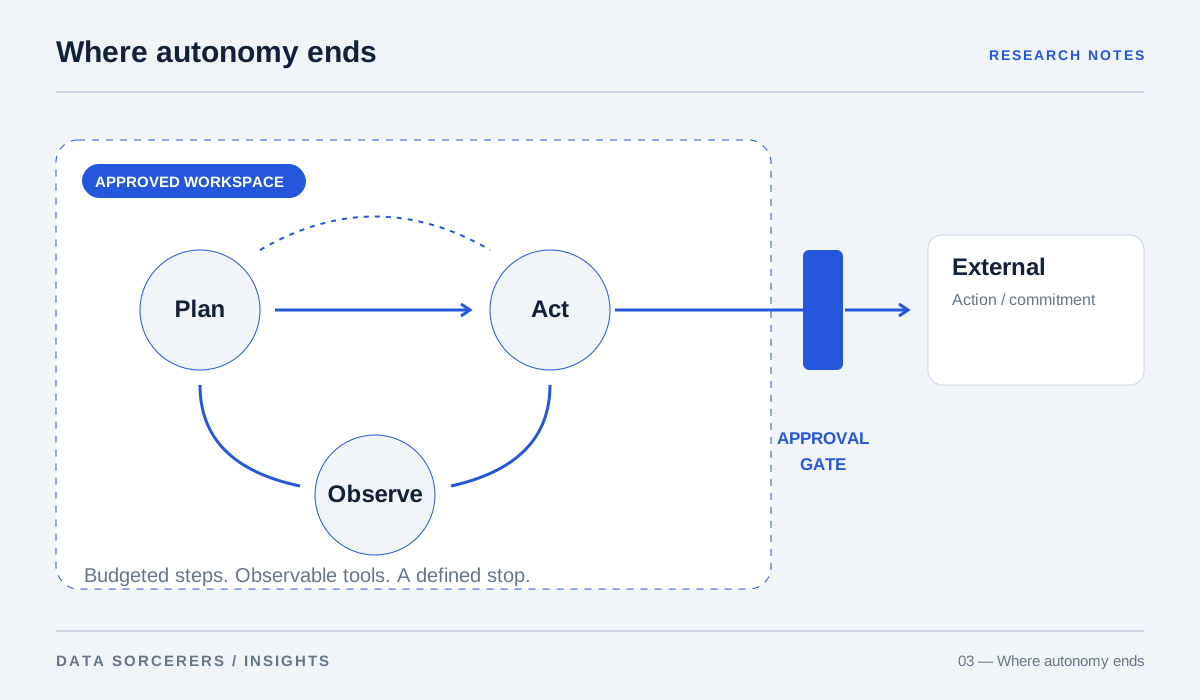
Our design recommendation is to represent permissions at the application layer. A research task can have read-only access to approved sources, while an external message or record change requires a separate authorization step. Give each action a narrow interface, validate its arguments, and connect approval to the specific proposed operation.
This follows from the distinction between task completion and authority, rather than from a claim that any benchmark provides a complete security architecture. An instruction to “ask before sending” may help the model behave, but a tool that cannot send without an approved action token provides a different kind of control. The user should see the destination, content, and consequence before authorizing a consequential step.
Evaluate the route as well as the result
Anthropic’s guidance on agent evaluations distinguishes tasks, trials, graders, and recorded trajectories, and discusses combining automated checks with human judgment. 10 A useful evaluation can inspect the final state while retaining enough of the tool sequence to diagnose failure. This does not require displaying private internal reasoning to the operator.
We suggest measuring completion, unauthorized actions, unnecessary retries, and human correction effort together. Add interruptions: a tool timeout, an unavailable source, a changed record, or a revoked permission. An assistant that succeeds only when every dependency responds cleanly has not demonstrated much operational resilience. Costs and elapsed time also matter, because a correct result reached through an uncontrolled loop may be unsuitable for routine use.
Reliability compounds across a sequence
Suppose, only as a mathematical illustration, that a task has ten necessary steps and each succeeds independently with probability 0.95. The probability that all ten succeed is 0.95 raised to the tenth power, approximately 0.60. This is not a measured agent success rate. Real steps are not necessarily independent, and recovery can change the outcome. The example simply explains why apparently strong local behavior does not guarantee reliable end-to-end execution.
Evaluate the complete task rather than multiplying benchmark scores from unrelated components. Then inspect where failures concentrate and whether recovery introduces new risk. τ-bench’s attention to repeated trials and resulting state is relevant to this distinction. 8 Shortening the action sequence, making a step deterministic, or validating a tool result may improve the system more than adding another round of free-form planning. The correct intervention depends on the observed trajectory, not on the arithmetic illustration.
Autonomy is a budget to allocate
A limited first deployment can be more informative than a broad “do anything” assistant. Start with a task whose outcome can be inspected, cap its time and tool calls, and provide a clear handoff when uncertainty remains. Expand one permission at a time after reviewing repeated evidence.
The research does not imply that more autonomous steps make a better product. It shows several ways to connect models with actions and several ways to expose their limitations. Our conclusion is that autonomy should be allocated where it removes meaningful work without obscuring responsibility. The mature agent is not the one that insists on finishing every task. It is the one whose operators can understand what it may do, verify what it did, and intervene before a mistake becomes a commitment.
Match autonomy to the task’s uncertainty and consequences, not to the appeal of the word “agent.”
Sources & methodology
This editorial synthesizes primary research, technical standards, and original engineering documentation. It is not an original experimental study or a systematic literature review. Research findings apply to the conditions studied; product recommendations are our interpretation. Figures explain concepts and do not present experimental measurements.
Sources checked on 31 October 2026. Publication dates and preprint versions may differ; the linked record identifies the referenced work. To suggest a correction, email contact@data-sorcerers.com.
- Anthropic (2024) — Building Effective Agents ↗Back to text ↑
- Yao et al. (2022) — ReAct: Synergizing Reasoning and Acting in Language Models ↗Back to text ↑
- Schick et al. (2023) — Toolformer: Language Models Can Teach Themselves to Use Tools ↗Back to text ↑
- Shinn et al. (2023) — Reflexion: Language Agents with Verbal Reinforcement Learning ↗Back to text ↑
- Liu et al. (2023) — AgentBench: Evaluating LLMs as Agents ↗Back to text ↑
- Zhou et al. (2023) — WebArena: A Realistic Web Environment for Building Autonomous Agents ↗Back to text ↑
- Jimenez et al. (2023) — SWE-bench: Can Language Models Resolve Real-World GitHub Issues? ↗Back to text ↑
- Yao et al. (2024) — τ-bench: A Benchmark for Tool-Agent-User Interaction in Real-World Domains ↗Back to text ↑
- Mialon et al. (2023) — GAIA: A Benchmark for General AI Assistants ↗Back to text ↑
- Anthropic (2026) — Demystifying Evals for AI Agents ↗Back to text ↑