In this analysis
The pilot ends where the organization begins
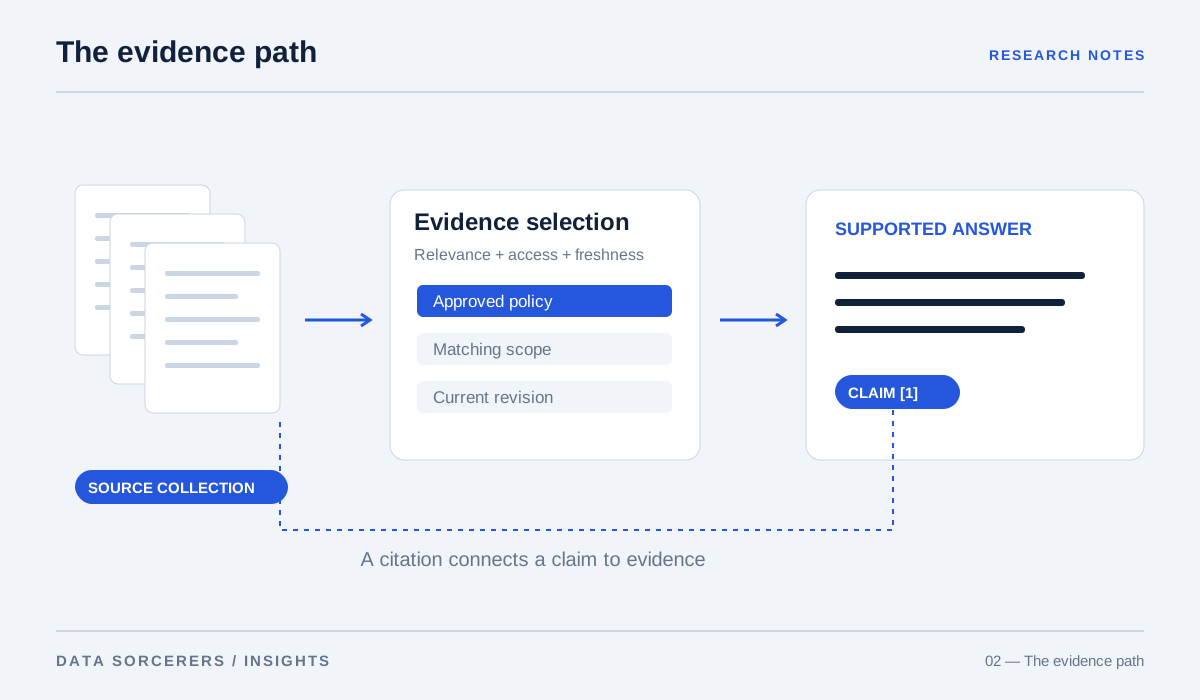
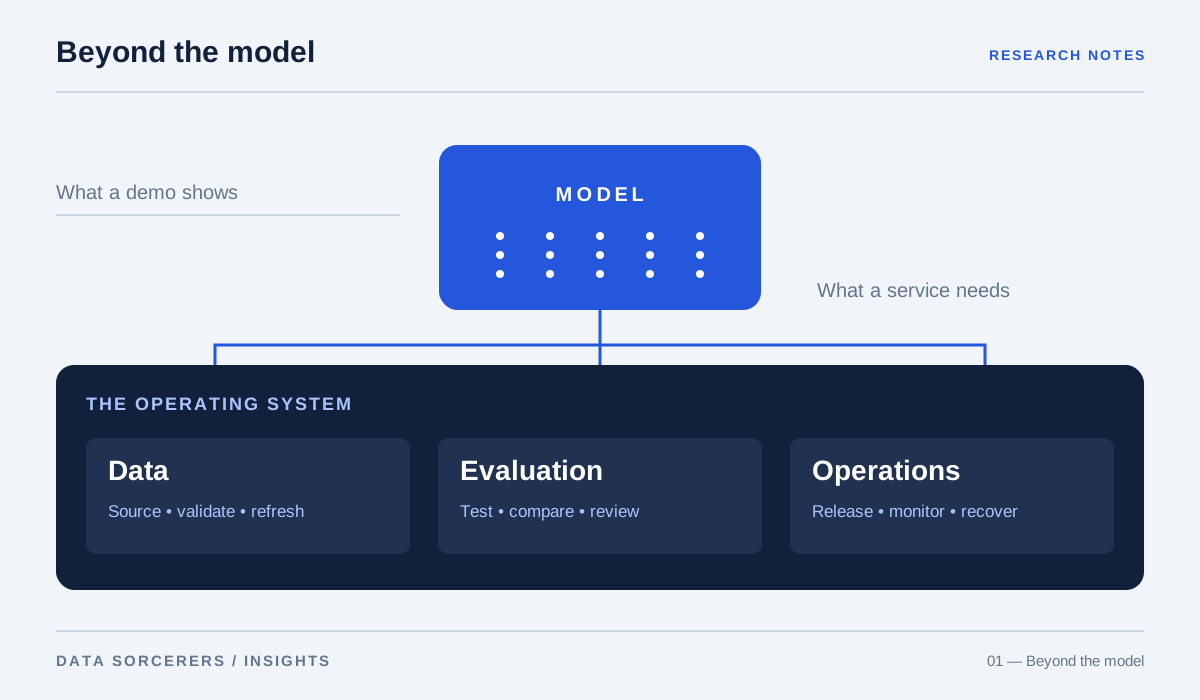
Imagine a policy assistant that gives an excellent answer in a meeting. A month later, an employee asks the same question after a policy revision. The answer is fluent, uses an obsolete document, and has no named owner to whom the employee can report the discrepancy. This is a hypothetical scenario, but it exposes a real distinction: demonstrating a model’s capability and establishing a dependable service are separate achievements. The production literature makes the surrounding dependencies central to that distinction. Sculley and colleagues describe how data dependencies, configuration, feedback loops, and hidden consumers accumulate technical debt around machine learning code. 1
The implication is not that every pilot needs a large platform. It is that the team must specify what the demonstration leaves unresolved. What decision will change? What happens when the input is incomplete? Can a person correct the result without learning the model’s internals? These questions define the product more precisely than a list of model capabilities.
What exactly has been proven?
An attractive demonstration is a selected observation. It may establish that the system can complete one task under particular conditions; it does not estimate how often it will succeed across ordinary demand. Google’s Rules of Machine Learning recommends simple initial systems and attention to infrastructure and measurement. The ML Test Score makes production readiness more explicit through checks spanning data, models, infrastructure, and monitoring. Together, these sources shift the release discussion from an impressive output toward inspectable operating evidence. 23
Our interpretation is to write a short claim before extending the pilot: for this user, on these inputs, the system improves this task without exceeding these failure limits. Each noun needs an owner and each limit needs a test. An unsupported generalization such as “automates knowledge work” gives an evaluator very little to falsify.
The unit of evaluation is a whole task
Consider the policy assistant again. Its useful output is not necessarily a paragraph. It may be a correct decision, a source that the employee can inspect, and an escalation when the policy does not resolve the case. Measure the time needed to reach that outcome, including verification and correction. Faster drafting accompanied by slower checking may not be an operational improvement. Compare equivalent tasks and retain unsuccessful attempts rather than reporting only completed ones.
Amershi and colleagues’ study of software engineering for machine learning describes an interconnected workflow in which data handling, model development, and deployment create coordination demands. TFX offers one production architecture that makes stages such as validation, training, evaluation, and serving explicit. Neither establishes that every organization needs the same stack; both help explain why a model-only comparison misses work outside inference. 48
Equal scores can conceal different behavior
A second complication is statistical. Two candidate models may achieve similar held-out performance while responding differently to a new hospital, camera, writing style, or operating condition. D’Amour and colleagues call attention to underspecification: the training procedure and conventional evaluation may leave important deployed behavior insufficiently determined. This is more subtle than discovering that a validation score was calculated incorrectly. 7
A practical response is to test plausible environments and important subgroups before selecting a release. For the assistant, that might include revised policies, ambiguous abbreviations, documents with conflicting effective dates, and questions that should not be answered. These are proposed product tests, not results from the cited study. Their purpose is to make the release claim narrower and more defensible.
Documentation becomes an interface between teams
Model Cards propose structured reporting of intended uses, evaluation conditions, and limitations. Datasheets for Datasets address the collection, composition, and recommended uses of data. These artifacts make assumptions available to people who did not build the original experiment. 56
For a small team, a useful implementation could be a versioned release record linking the model identifier, retrieval snapshot, evaluation set, permissions, and known failure cases. The record should answer a support engineer’s question at the moment something goes wrong. A beautifully formatted document that cannot identify which policy version produced an answer offers little operational help. Documentation earns its place when it shortens an investigation or prevents an inappropriate reuse.
Automation changes the meaning of a release
In conventional application delivery, a source-code change often initiates a release. In machine learning, new data, a retrained model, or an upstream service change can alter behavior while much of the application code remains stable. Google Cloud’s MLOps guidance describes continuous training and automated validation as additional concerns alongside software delivery. 9
That does not make automatic retraining the default answer. A team should first decide which changes trigger evaluation, who can approve promotion, and how a previous working configuration is restored. If the assistant’s corpus changes daily but evaluation occurs quarterly, a claim about the tested system becomes stale quickly. The cadence of assurance must follow the cadence of meaningful change.
Monitor consequences as well as components
Google’s SRE monitoring guidance distinguishes externally visible behavior from internal instrumentation. For an AI service, an available endpoint and a successful response code establish only part of the picture. 10 A production dashboard might therefore connect request failures with answer verification, retrieval freshness, escalation rates, and correction effort. The exact measures depend on the task; these are suggested measures, not universal thresholds.
There is a further challenge: human feedback can be selective. A busy employee may silently repair a bad answer instead of reporting it. Review a sample of normal usage, make correction easy, and watch whether the system changes the work that is recorded. Monitoring should help people discover a problem while they still have a practical way to intervene.
Separate task value from inference speed
A simple accounting identity makes the deployment question sharper: total task time equals preparation, model execution, verification, correction, and handoff time. This is an editorial measurement model, not a result reported by the sources. If a hypothetical workflow saves four minutes of drafting but adds five minutes of checking, its net time effect is negative even though inference appears fast. Quality may still improve, but that is a separate claim requiring evidence.
Compare distributions rather than only averages: a system that saves time on routine cases may create long recovery episodes on exceptions. Track the same task boundaries before and after deployment, and account for differences in case difficulty. This operational view complements the testing and monitoring emphasis of the ML Test Score. 2 It also makes a decision reversible: the team can identify which stage consumes the expected benefit rather than treating the entire pilot as an indivisible success or failure.
A smaller launch can produce stronger evidence
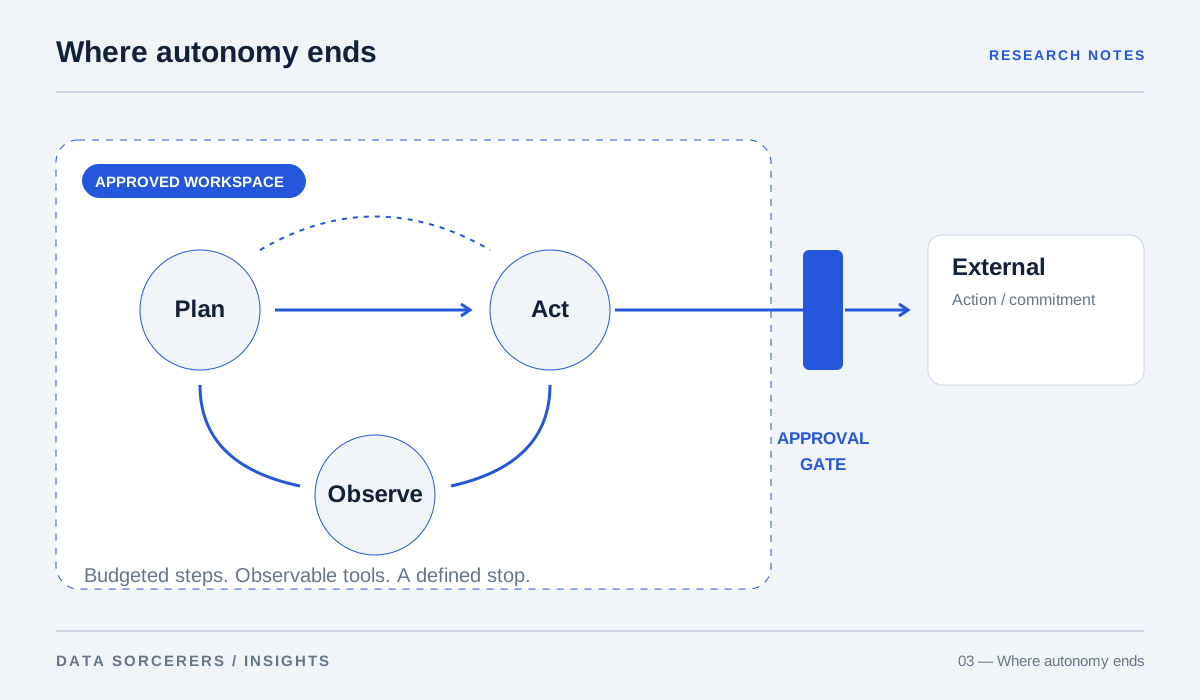
The most defensible first release may serve a single team, one authoritative collection, and a limited set of decisions. This is an experimental design choice: fewer moving parts make a failure easier to attribute. Keep a fallback process, preserve the conditions of the evaluation, and agree in advance what evidence would justify expansion.
The scientific literature does not provide a universal pilot-to-production checklist that guarantees success. Its contribution is to reveal recurring sources of uncertainty and operational debt. Our recommendation is to use that knowledge to make a smaller, testable promise. The milestone worth celebrating is not merely that the assistant can answer. It is that a team can explain when to trust the answer, detect when the conditions have changed, and recover when the service is wrong.
Before expanding an AI pilot, name the workflow owner, the review path, and the outcome you will measure.
Sources & methodology
This editorial synthesizes primary research, technical standards, and original engineering documentation. It is not an original experimental study or a systematic literature review. Research findings apply to the conditions studied; product recommendations are our interpretation. Figures explain concepts and do not present experimental measurements.
Sources checked on 31 October 2026. Publication dates and preprint versions may differ; the linked record identifies the referenced work. To suggest a correction, email contact@data-sorcerers.com.
- Sculley et al. (2015) — Hidden Technical Debt in Machine Learning Systems ↗Back to text ↑
- Breck et al. (2017) — The ML Test Score: A Rubric for ML Production Readiness and Technical Debt Reduction ↗Back to text ↑
- Zinkevich — Rules of Machine Learning: Best Practices for ML Engineering ↗Back to text ↑
- Baylor et al. (2017) — TFX: A TensorFlow-Based Production-Scale Machine Learning Platform ↗Back to text ↑
- Mitchell et al. (2019) — Model Cards for Model Reporting ↗Back to text ↑
- Gebru et al. (2021) — Datasheets for Datasets ↗Back to text ↑
- D’Amour et al. (2020) — Underspecification Presents Challenges for Credibility in Modern Machine Learning ↗Back to text ↑
- Amershi et al. (2019) — Software Engineering for Machine Learning: A Case Study ↗Back to text ↑
- Google Cloud — MLOps: Continuous Delivery and Automation Pipelines in Machine Learning ↗Back to text ↑
- Ewaschuk / Google SRE — Monitoring Distributed Systems ↗Back to text ↑