In this analysis
The document in the answer
A manager asks an internal assistant whether a customer qualifies for a service exception. The assistant finds a policy, cites it, and delivers a confident response. The policy is genuine. It is also last year’s version. This hypothetical case illustrates why connecting a language model to documents does not finish the knowledge problem. Retrieval makes external evidence available, but somebody still has to establish which evidence is authoritative, relevant, current, and accessible to the person asking.
The original retrieval-augmented generation research combines a parametric language model with a retrievable external collection. Its experiments show the value of that combination on knowledge-intensive tasks. They do not establish that an arbitrary folder of company files becomes a reliable assistant when indexed. 1 The operational question moves from “What does the model remember?” to “What evidence reaches it, under what conditions?”
Similarity is the start of relevance
Dense Passage Retrieval learns representations that support matching a question with useful passages. ColBERTv2 explores a different retrieval trade-off through token-level representations and late interaction. Both are contributions to the problem of finding evidence, rather than guarantees that a retrieved passage answers the business question. 210
A passage about service exceptions can be semantically similar to the query and still concern the wrong market, date, or customer category. Our recommendation is to treat those attributes as explicit constraints where possible. Evaluate retrieval using questions whose required evidence is known. Include near-miss documents that share vocabulary with the right source. Otherwise, an evaluation may reward topical resemblance while overlooking the distinction the user actually needs.
A collection has a history
The KILT benchmark connects knowledge-intensive tasks to a shared knowledge source and evaluates provenance as well as task performance. Its relevance to enterprise design is that the source of an answer can be an evaluation target in its own right. 3 A correct statement with the wrong supporting document should not be treated as equivalent to an answer backed by the authoritative record.
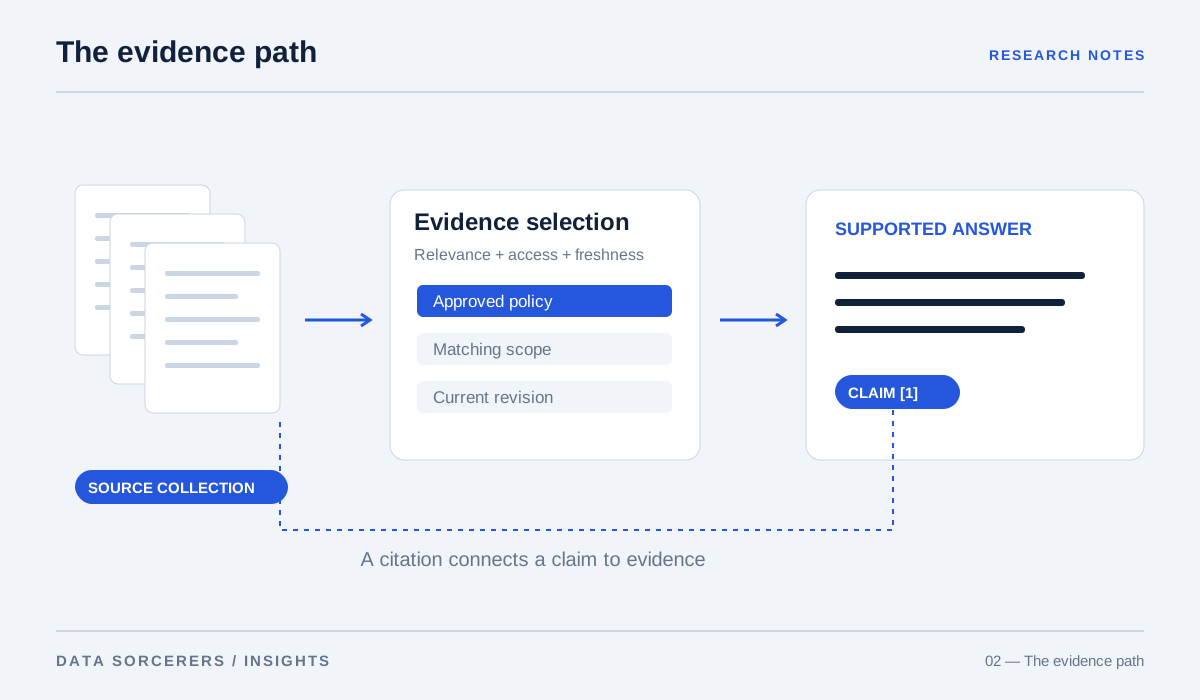
In our hypothetical policy assistant, preserve document identifiers, revision dates, owners, and permission rules alongside text. Decide whether archived material remains searchable and how a corrected document invalidates earlier chunks. These are editorial and information-management decisions, not just vector-index settings. If two policies disagree, the system needs a visible policy for handling the disagreement rather than a hidden preference for whichever passage scores highest.
More context is not automatically better context
Longer input windows appear to offer a straightforward remedy: provide more of the library. Lost in the Middle finds that the models and tasks studied can be sensitive to where relevant information appears in a long context. Fusion-in-Decoder research, meanwhile, investigates how a generative model can combine multiple retrieved passages. The two results concern different architectures and settings, but both make the arrangement and use of evidence part of the problem. 49
A sensible experiment therefore varies passage selection, ordering, and redundancy while holding the evaluation questions constant. Inspect whether a crucial exception disappears among repetitive text. Avoid interpreting a larger context budget as evidence of improved comprehension. The budget is a capacity limit; successful use of that capacity remains an empirical question.
The citation must support the sentence
A reference beside a sentence can create an appearance of verification. The ALCE research on generating text with citations separates dimensions including correctness and citation quality, making clear that readable output and well-supported output are not the same evaluation target. 7 A source may mention the topic without entailing the claim, or support only one clause in a broader statement.
For the policy assistant, ask reviewers to examine the connection between each consequential claim and its cited passage. Does the passage support the amount, date, jurisdiction, or exception stated? Can the user open it? Is an inference being presented as an explicit rule? The desired interface makes checking easier; it does not transfer all responsibility to a reader faced with a long list of loosely related links.
Diagnose the pipeline before replacing the model
Ragas proposes automated evaluation of several RAG dimensions, including retrieval and answer faithfulness. ARES evaluates context relevance, answer faithfulness, and answer relevance using trained judges with human-labeled data supporting its estimation procedure. These approaches help separate failure types, but automated evaluators require validation in the language and domain where they are used. 56
Suppose an answer omits a crucial condition. The retrieval stage may never have found it, the context assembly may have removed it, or the generation stage may have ignored it. Those failures imply different interventions. Keep intermediate evidence visible to the evaluator. A single satisfaction score can show that something is wrong while providing very little guidance about what to repair.
Knowing when not to retrieve—or answer
Self-RAG explores learning when to retrieve and how to critique retrieved material and generated responses. Its results provide evidence for a particular research approach, not a universal mechanism for recognizing uncertainty. 8 The broader product question remains useful: should every question produce a confident answer?
We propose evaluating deliberately unanswerable cases, questions outside the permitted collection, and requests requiring a human decision. A useful response may identify the missing information, show conflicting sources, or explain the route to an authorized reviewer. The interface should distinguish “no evidence found” from “the policy says no.” Those statements have different meanings, and collapsing them can turn a retrieval failure into an incorrect organizational decision.
Measure the missing link
Retrieval recall at a chosen cutoff asks whether required evidence appears among the returned passages. Answer faithfulness asks whether the generated claims are supported by the supplied context. Neither alone establishes that the answer resolves the user’s question. The evaluation frameworks reviewed above separate these dimensions for precisely this reason. 56
Consider a hypothetical answer that perfectly summarizes an obsolete policy. It may be faithful to the context while wrong for the current task. Conversely, an answer can be correct by coincidence while unsupported by the retrieved material. Build an evaluation record that contains the question, authoritative evidence, retrieved passages, answer, and adjudicated outcome. That structure allows the reviewer to locate the broken link. It also prevents a misleading optimization: increasing retrieval volume until the right document appears somewhere, while ignoring whether irrelevant or conflicting passages make the final answer less dependable.
The knowledge service after launch
A dependable RAG product requires recurring attention to the collection as well as the model. Sample new questions, recheck access behavior, and test the effect of document revisions. Keep retrieval and generation evaluations separate enough to diagnose change, then assess the complete user task to see whether the system actually helps.
The evidence reviewed here supports retrieval as a valuable architecture, while also showing why source selection, context use, and evaluation need their own scrutiny. Our conclusion is deliberately narrower than a promise of hallucination-free answers. RAG can make an assistant more inspectable when evidence is governed, claims are checked against that evidence, and uncertainty remains visible. A system that admits it cannot resolve a policy conflict may be doing better work than one that supplies a seamless answer.
Evaluate the evidence path as carefully as the generated answer.
Sources & methodology
This editorial synthesizes primary research, technical standards, and original engineering documentation. It is not an original experimental study or a systematic literature review. Research findings apply to the conditions studied; product recommendations are our interpretation. Figures explain concepts and do not present experimental measurements.
Sources checked on 31 October 2026. Publication dates and preprint versions may differ; the linked record identifies the referenced work. To suggest a correction, email contact@data-sorcerers.com.
- Lewis et al. (2020) — Retrieval-Augmented Generation for Knowledge-Intensive NLP Tasks ↗Back to text ↑
- Karpukhin et al. (2020) — Dense Passage Retrieval for Open-Domain Question Answering ↗Back to text ↑
- Petroni et al. (2021) — KILT: A Benchmark for Knowledge Intensive Language Tasks ↗Back to text ↑
- Liu et al. (2023) — Lost in the Middle: How Language Models Use Long Contexts ↗Back to text ↑
- Es et al. (2023) — Ragas: Automated Evaluation of Retrieval Augmented Generation ↗Back to text ↑
- Saad-Falcon et al. (2024) — ARES: An Automated Evaluation Framework for Retrieval-Augmented Generation Systems ↗Back to text ↑
- Gao et al. (2023) — Enabling Large Language Models to Generate Text with Citations ↗Back to text ↑
- Asai et al. (2023) — Self-RAG: Learning to Retrieve, Generate, and Critique through Self-Reflection ↗Back to text ↑
- Izacard and Grave (2021) — Leveraging Passage Retrieval with Generative Models for Open Domain Question Answering ↗Back to text ↑
- Santhanam et al. (2022) — ColBERTv2: Effective and Efficient Retrieval via Lightweight Late Interaction ↗Back to text ↑