In this analysis
A narrow task changes the comparison
An organization wants to classify incoming support messages into a fixed set of queues. Another wants an assistant to investigate unfamiliar technical problems across a large document collection. Both may involve language models, but they are different workloads. Choosing a model before separating those tasks risks paying for capabilities that one workflow does not need, while underestimating the demands of the other.
The Phi-3 technical report documents substantial capabilities in a smaller model family under the authors’ training and evaluation conditions. It is evidence that parameter count alone does not determine usefulness, not proof that a particular compact model will meet an organization’s requirements. 1 A deployment decision must still connect model behavior to the actual inputs, hardware, and consequences of error.
Training efficiency is not serving efficiency
Hoffmann and colleagues’ compute-optimal training research examines how model size and training data interact under a training-compute budget. Its conclusions concern the allocation of training resources, rather than a direct prescription for every inference workload. 8 A model trained efficiently may still be too slow, too memory-intensive, or insufficiently accurate for a particular deployment.
Our recommendation is to separate three questions: how the model was trained, what it can do on representative tasks, and what it costs to operate at the required load. The relevant denominator is a completed, acceptable task. A cheaper request that produces more retries and manual correction may cost more in practice. Likewise, a capable model with excessive startup time may be unsuitable for intermittent local use.
Distillation changes the learning problem
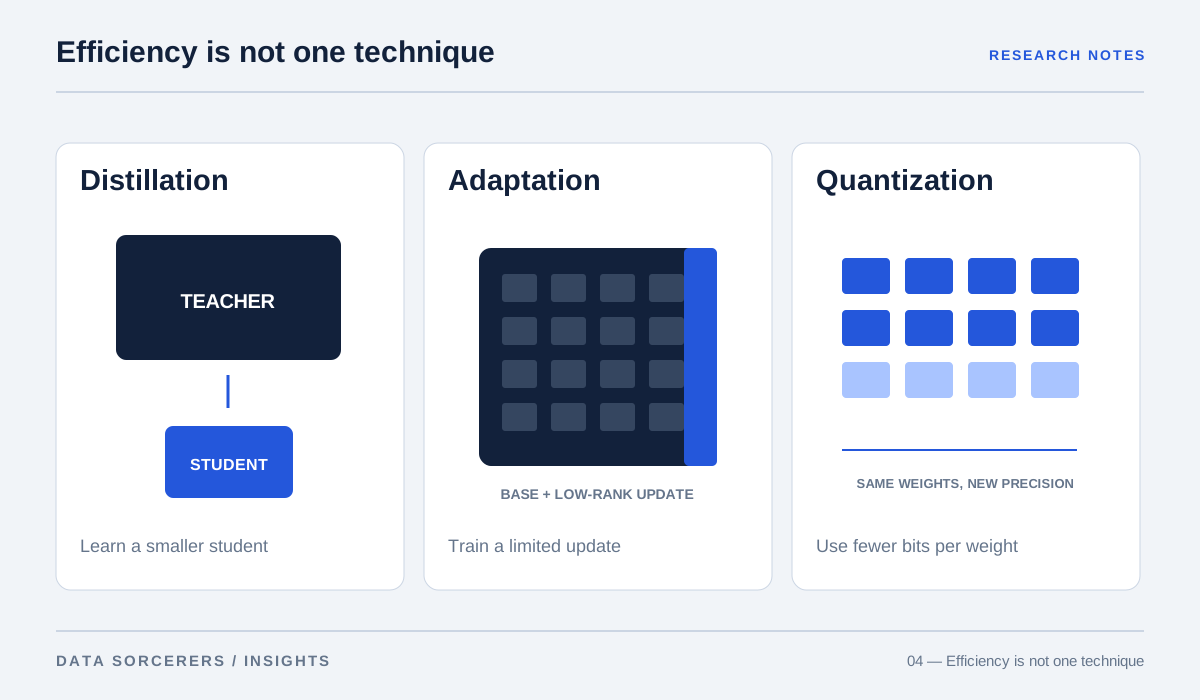
Knowledge distillation transfers information from a teacher model to a student, often using richer training targets than hard labels alone. DistilBERT demonstrates a compact language representation model developed through a distillation approach. These are related contributions, but a technique demonstrated for one architecture and objective does not automatically preserve every capability in a different generative system. 23
For the support-routing example, a student could be trained on a carefully reviewed task distribution. The important test is whether it handles ambiguous and uncommon messages, not just whether it imitates the teacher on frequent ones. Teacher errors can enter the training targets. A smaller model inherits neither an exemption from data quality work nor a guarantee of better behavior merely because its scope is narrower.
Adaptation and compression are different operations
LoRA reduces the number of trainable parameters required for adaptation by representing updates through low-rank matrices. QLoRA combines quantized base-model storage with low-rank adaptation to reduce fine-tuning memory requirements. 45 Neither should be described simply as shrinking a model into a new, inherently faster architecture. The serving result depends on how weights, adapters, and inference kernels are deployed.
This distinction matters in project estimates. A team may successfully fine-tune a large model on limited hardware and still lack the infrastructure to serve it at the required concurrency. Before committing, test the actual deployment format. Record whether adapters are merged or applied separately, which numeric representation is used, and whether the runtime supports the intended execution path.
Fewer bits do not remove the need to evaluate
GPTQ investigates post-training quantization for generative transformers. AWQ uses activation information to guide weight quantization and support efficient execution. Both address memory and computation trade-offs, but their reported results depend on models, evaluation tasks, hardware, and implementations. 67
The first-order storage calculation is straightforward: parameter count multiplied by bits per parameter estimates raw weight storage. It is not total runtime memory. Metadata, activations, attention caches, and framework overhead also consume memory. Nor does the calculation predict answer quality. Test the quantized model on the same difficult examples as the higher-precision baseline, including long inputs and infrequent categories. A small overall difference can hide a larger regression in the cases that matter most.
The workload has a shape
PagedAttention addresses memory management for attention key-value caches in language-model serving. FlashAttention reduces memory traffic for exact attention through an IO-aware implementation. These works demonstrate why systems design can change serving efficiency without simply changing the number of model parameters. 910
For a real service, measure time to first output, total completion time, throughput, and memory under expected input lengths and simultaneous demand. A benchmark with one short request is not a capacity plan for many long conversations. Local deployment introduces further constraints: hardware availability, battery use, update distribution, and the operational effort required to support different devices. Those are product considerations that a model leaderboard cannot resolve.
A fair comparison preserves the whole workflow
We propose a staged experiment. Begin with a simple baseline for the actual task; for a fixed classification problem, that need not be a generative model. Compare candidate systems on the same held-out messages, permission constraints, and acceptance rules. Then replay realistic bursts of work and inspect failures, rather than testing only average load.
Include the human review process in the comparison. If low-confidence cases are escalated, measure both the fraction escalated and the quality of those that pass through. Otherwise, a model can appear more accurate by quietly transferring most difficult work to people. Documenting that trade-off is more useful than declaring a universal winner between “small” and “large” models.
Estimate memory without mistaking it for a benchmark
For illustration, eight billion weights stored at four bits each require roughly four billion bytes, or four decimal gigabytes, for the raw weight values. The calculation is parameter count multiplied by bits per weight, divided by eight. It excludes quantization metadata, activations, runtime buffers, and the key-value cache. It is therefore a lower-level storage estimate, not a promise that an eight-billion-parameter model will run within four gigabytes of device memory.
The key-value cache also depends on architecture, sequence length, precision, and concurrent requests. PagedAttention addresses how that cache is managed during serving. 9 A model can fit when processing one short request and fail under longer or simultaneous conversations. Use the estimate to eliminate obviously unsuitable configurations, then measure the actual runtime. Reporting both theoretical weight storage and observed operating memory makes the trade-off intelligible without confusing a calculation with experimental evidence.
Size is an engineering choice, not an identity
The literature supports several routes to efficiency: better training allocation, distillation, parameter-efficient adaptation, quantization, and improved serving implementations. They address different bottlenecks and cannot be substituted for one another without testing. The decision should follow the bottleneck that actually limits the product.
A compact model can be an excellent fit when its task is well specified and its limitations are acceptable. A larger model may remain justified when difficult reasoning or diverse inputs materially improve completed outcomes. Our recommendation is to choose the smallest operational system that meets the evidence-based requirement, including its fallback and review mechanisms. That is a more demanding standard than selecting the smallest model—and a more useful one for the people who depend on it.
Compare complete workflows on your own tasks before choosing a model by size.
Sources & methodology
This editorial synthesizes primary research, technical standards, and original engineering documentation. It is not an original experimental study or a systematic literature review. Research findings apply to the conditions studied; product recommendations are our interpretation. Figures explain concepts and do not present experimental measurements.
Sources checked on 31 October 2026. Publication dates and preprint versions may differ; the linked record identifies the referenced work. To suggest a correction, email contact@data-sorcerers.com.
- Abdin et al. (2024) — Phi-3 Technical Report: A Highly Capable Language Model Locally on Your Phone ↗Back to text ↑
- Hinton, Vinyals and Dean (2015) — Distilling the Knowledge in a Neural Network ↗Back to text ↑
- Sanh et al. (2019) — DistilBERT, a Distilled Version of BERT: Smaller, Faster, Cheaper and Lighter ↗Back to text ↑
- Hu et al. (2021) — LoRA: Low-Rank Adaptation of Large Language Models ↗Back to text ↑
- Dettmers et al. (2023) — QLoRA: Efficient Finetuning of Quantized LLMs ↗Back to text ↑
- Frantar et al. (2022) — GPTQ: Accurate Post-Training Quantization for Generative Pre-trained Transformers ↗Back to text ↑
- Lin et al. (2023) — AWQ: Activation-aware Weight Quantization for LLM Compression and Acceleration ↗Back to text ↑
- Hoffmann et al. (2022) — Training Compute-Optimal Large Language Models ↗Back to text ↑
- Kwon et al. (2023) — Efficient Memory Management for Large Language Model Serving with PagedAttention ↗Back to text ↑
- Dao et al. (2022) — FlashAttention: Fast and Memory-Efficient Exact Attention with IO-Awareness ↗Back to text ↑