In this analysis
The average is an incomplete story
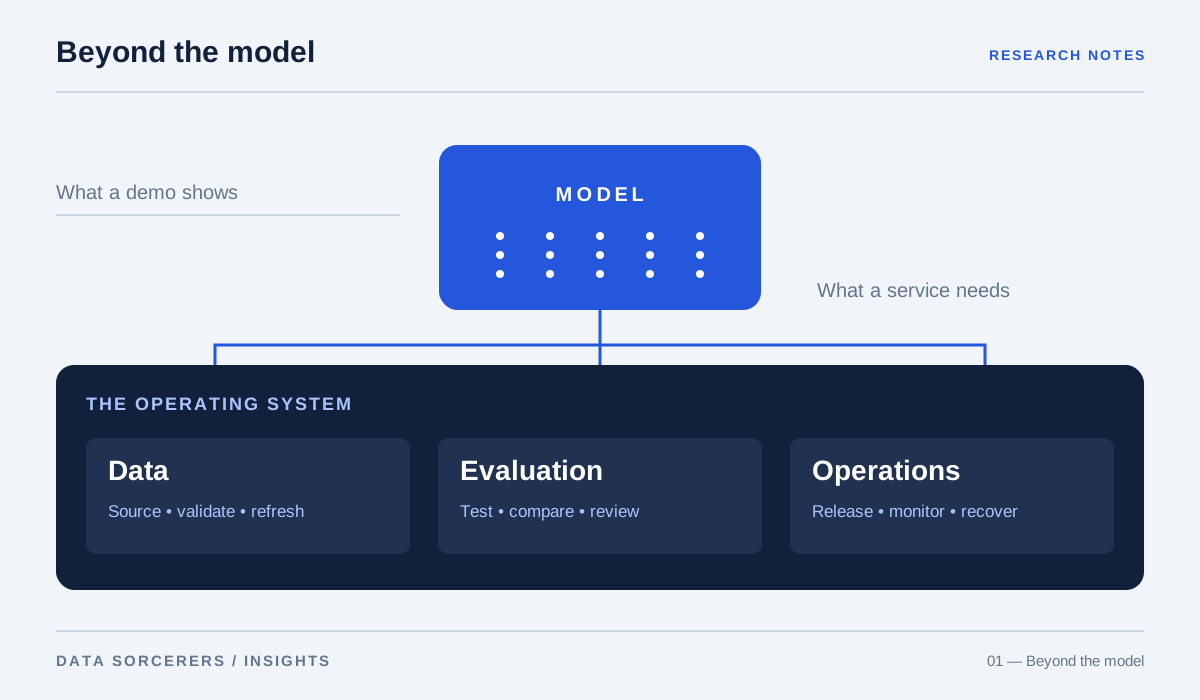
A product team compares two models. One wins on an aggregate score, so it becomes the obvious release candidate. Yet the evaluation combines routine requests with rare, consequential cases. A modest improvement on common examples can conceal a deterioration where the organization most needs dependable behavior. The score is not necessarily wrong. The question it answers may be too broad for the decision.
HELM evaluates language models across multiple scenarios and dimensions, while MMLU tests knowledge and problem-solving across a broad collection of subjects. Their designs make different aspects of capability visible. Neither is a substitute for specifying what a particular product must do. 12 Evaluation becomes useful when the measurement, the deployment setting, and the release decision refer to the same task.
Truthfulness is not fluency
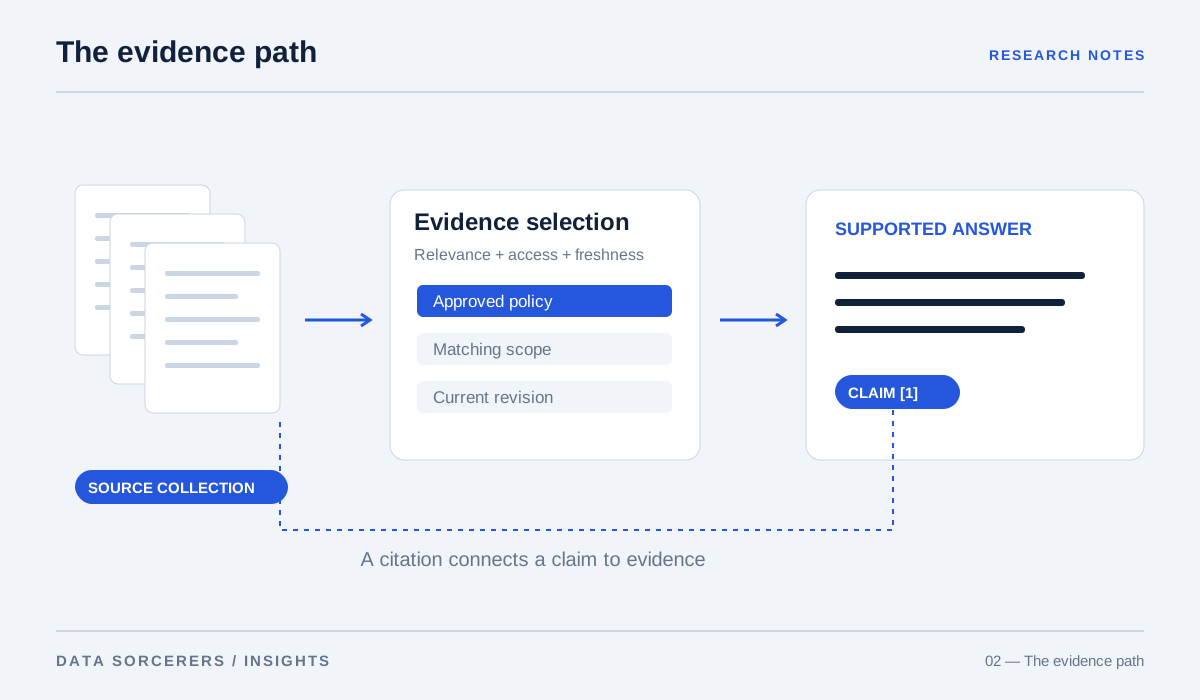
TruthfulQA investigates whether models reproduce falsehoods associated with human misconceptions. The study illustrates why a plausible-sounding answer can fail a test of truthfulness even when its grammar and topical relevance are strong. 3 The practical lesson is to avoid allowing presentation quality to stand in for factual support.
Consider a hypothetical learning assistant. A response might be clear and encouraging but give an incorrect explanation of a scientific concept. A general preference score could reward its tone while overlooking the error. We recommend grading factual correctness, explanatory usefulness, and the handling of uncertainty separately before combining them. The product team must then decide which failures are disqualifying, rather than letting an average make that decision implicitly.
Test a behavior, not just a collection of examples
CheckList proposes behavioral testing for NLP systems through capabilities and test types, including minimum-functionality, invariance, and directional-expectation tests. 7 This makes it possible to ask whether a model responds appropriately to a controlled change in input, instead of measuring only its performance on an undifferentiated dataset.
For the learning assistant, changing a student’s name should not change a mathematical answer. Introducing a missing premise should change how confidently the assistant responds. These are proposed product tests, not claims about the CheckList experiments. Their usefulness lies in making expectations explicit. When a test fails, the team can describe the violated behavior and investigate its cause instead of saying only that the model lost a fraction of a point.
The deployment population may move
WILDS studies distribution shifts that arise in real settings. D’Amour and colleagues’ work on underspecification adds a related warning: models that look similar under standard evaluation may behave differently in deployment. 69 These are distinct problems. One concerns differences between data distributions; the other concerns important behavior left unresolved by the training and evaluation procedure.
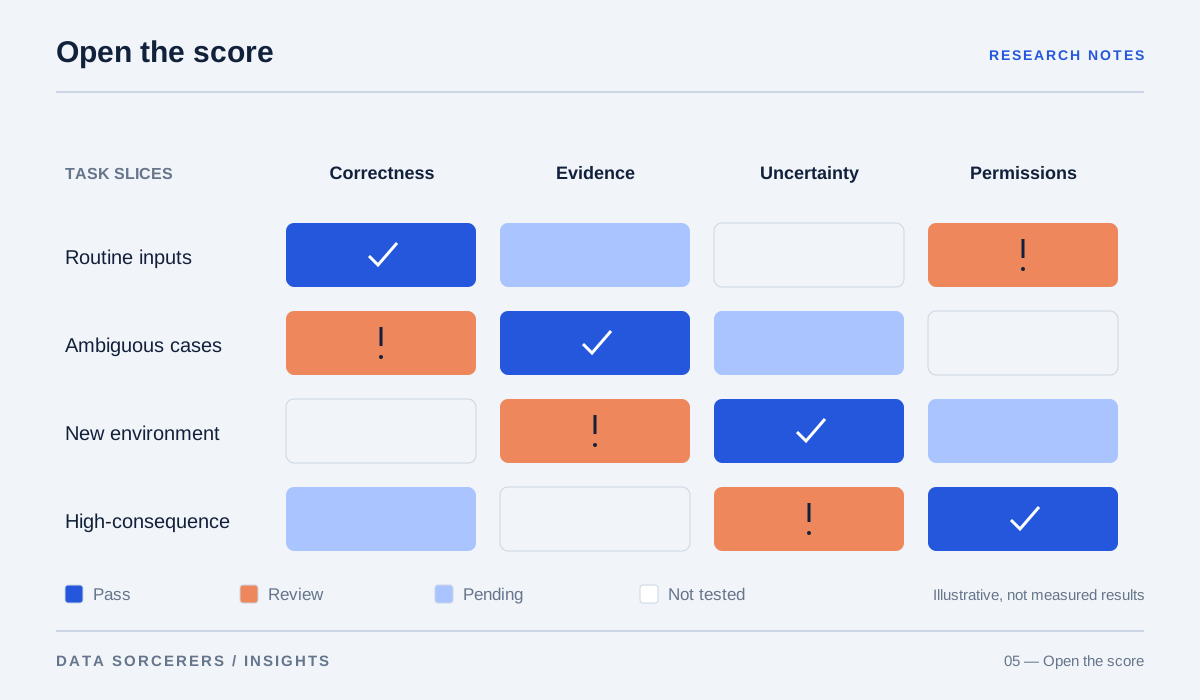
A release review should therefore include plausible changes in users, languages, input quality, and context. Report performance by meaningful slices where sample sizes permit, and state when estimates are too uncertain to interpret. A small subgroup should not disappear from discussion merely because its estimate is noisy. Nor should a noisy estimate be presented as a precise finding about that population.
Confidence needs its own validation
Guo and colleagues show that modern neural networks can be miscalibrated and examine methods for improving calibration. Angelopoulos and Bates explain conformal prediction and its coverage guarantees under appropriate assumptions. 58 Calibration, uncertainty estimation, and correctness are related, but they are not interchangeable properties.
A model can be calibrated in aggregate while still making serious errors. Conformal coverage is commonly marginal rather than guaranteed for every individual subgroup, and distributional assumptions matter. A deployment team should ask what the uncertainty statement actually promises and whether the operating data satisfy the conditions behind it. Turning a confidence value into an automatic approval rule without that discussion can give an uncertain system a misleading appearance of mathematical assurance.
A judge is another measurement instrument
LLM-based judges can make evaluation more scalable, but the MT-Bench and Chatbot Arena study documents biases such as sensitivity to answer position and verbosity. 4 A judge’s output should therefore be treated as a measurement with limitations, not as an unquestionable ground truth.
Use an explicit rubric and compare a sample of judgments with qualified human reviewers. Investigate disagreements rather than automatically treating one side as correct. Keep the judge configuration stable during a comparison, and test whether superficial changes alter its verdict. A longer answer should not receive a higher factuality score merely because it sounds more complete. Human review also needs clear criteria; substituting an unstructured opinion for an automated score does not solve the measurement problem.
Reproducibility is part of the result
Picard’s study of random seeds in computer-vision training examines variation that can arise from experimental randomness. Its findings concern the architectures and settings studied, but the methodological warning travels: a selected run can be mistaken for a stable advantage. 10 Report the conditions of the comparison and repeat experiments where randomness could materially affect the conclusion.
For a generative application, that may mean repeated trials, controlled model versions, and recorded tool environments. For a trained classifier, it may include multiple training seeds and uncertainty around performance estimates. Preserve the evaluation set and note its limitations. A result that cannot be reconstructed is difficult to distinguish from a favorable accident when the system changes.
A rare event can defeat an impressive accuracy score
Imagine a synthetic dataset of one thousand cases containing ten positive events. A classifier that always predicts negative achieves 99 percent accuracy while detecting none of those events. These numbers are an arithmetic illustration, not a reported study. They explain why the relevant error structure must accompany an aggregate score.
Precision describes how many predicted positives are actually positive; recall describes how many actual positives are detected. Changing the decision threshold can trade one against the other, and the acceptable balance depends on the consequences of false alarms and missed events. Calibration asks a different question about predicted probabilities. 5 For a deployment decision, present the confusion pattern at the proposed operating threshold and explain who experiences each type of error. A broad benchmark can motivate further investigation, but it cannot choose that threshold or the organization’s tolerance for harm.
Turn evidence into a release decision
We recommend defining three outputs from an evaluation: a capability profile, a failure inventory, and an explicit decision. The capability profile describes where the system works. The failure inventory identifies consequential cases and their frequency or uncertainty. The decision states whether the system can be released, narrowed, or held for further work.
No single benchmark can choose the acceptable trade-off on behalf of the organization. That requires understanding who bears the cost of an error and what alternatives are available. Scientific evaluation contributes discipline: controlled comparisons, transparent assumptions, reproducibility, and calibrated conclusions. The strongest release argument is not “our score is high.” It is that the evidence supports this particular use, under these conditions, with these remaining limits.
Use aggregate scores to start a discussion, then inspect the errors that could change the decision.
Sources & methodology
This editorial synthesizes primary research, technical standards, and original engineering documentation. It is not an original experimental study or a systematic literature review. Research findings apply to the conditions studied; product recommendations are our interpretation. Figures explain concepts and do not present experimental measurements.
Sources checked on 31 October 2026. Publication dates and preprint versions may differ; the linked record identifies the referenced work. To suggest a correction, email contact@data-sorcerers.com.
- Liang et al. (2022) — Holistic Evaluation of Language Models ↗Back to text ↑
- Hendrycks et al. (2020) — Measuring Massive Multitask Language Understanding ↗Back to text ↑
- Lin, Hilton and Evans (2021) — TruthfulQA: Measuring How Models Mimic Human Falsehoods ↗Back to text ↑
- Zheng et al. (2023) — Judging LLM-as-a-Judge with MT-Bench and Chatbot Arena ↗Back to text ↑
- Guo et al. (2017) — On Calibration of Modern Neural Networks ↗Back to text ↑
- Koh et al. (2020) — WILDS: A Benchmark of in-the-Wild Distribution Shifts ↗Back to text ↑
- Ribeiro et al. (2020) — Beyond Accuracy: Behavioral Testing of NLP Models with CheckList ↗Back to text ↑
- Angelopoulos and Bates (2021) — A Gentle Introduction to Conformal Prediction and Distribution-Free Uncertainty Quantification ↗Back to text ↑
- D’Amour et al. (2020) — Underspecification Presents Challenges for Credibility in Modern Machine Learning ↗Back to text ↑
- Picard (2021) — Torch.manual_seed(3407) Is All You Need: On the Influence of Random Seeds in Deep Learning Architectures for Computer Vision ↗Back to text ↑