In this analysis
The policy becomes a product decision
An organization publishes a commitment to responsible AI. Later, a team must decide whether an assistant can recommend a consequential action without review, which records it may access, and how a person can challenge its output. The policy matters only if it helps answer those questions. This hypothetical gap between principle and implementation is where governance becomes an operating practice.
NIST’s AI Risk Management Framework organizes risk work around governance, mapping, measurement, and management. Its Generative AI Profile adds considerations associated with generative systems. 12 These are frameworks for organizing judgment, not certificates that a product is safe or a substitute for context-specific legal obligations. Their practical value comes from connecting concerns to decisions, evidence, and responsibility.
Identify everyone who can be affected
The immediate user is not always the only person affected by an AI system. A teacher may operate a learning tool whose outputs influence students. A manager may use an analysis that shapes opportunities for employees. The relevant question is therefore broader than whether the interface satisfies its purchaser.
Selbst and colleagues examine how abstractions in technical fairness work can lose important sociotechnical context. 7 Our interpretation is to map the surrounding process before selecting a metric. Who can correct the input? Who sees the output? Who bears the cost of a mistake? A model-level improvement may not resolve an unfair process if the workflow around the model continues to distribute consequences poorly.
Documentation should expose assumptions
Model Cards propose reporting intended uses, evaluation conditions, and limitations. Datasheets for Datasets focus on the circumstances and composition of data. 34 These documents can help an organization understand what a system was developed for and where its evidence is thin.
They should not be treated as a substitute for evaluation or as paperwork completed once at launch. In a hypothetical education assistant, a dataset description might reveal that certain languages or age groups are poorly represented. That finding should affect testing and deployment scope. A limitation that appears only in a document while the product advertises universal suitability has not been operationalized. The public promise and the evidence need to remain aligned.
Fairness requires a choice about the decision
Hardt, Price and Srebro formulate equality of opportunity for supervised learning in terms of error-rate relationships. Fairness and Machine Learning examines multiple definitions, assumptions, and limitations. 68 These works make clear that fairness is not a single numeric property that can be selected independently of the application.
A team must decide which outcomes and groups matter, how labels were produced, and whether a proposed metric reflects the harm under discussion. Different criteria can conflict, and observed labels may encode earlier institutional decisions. Report the criterion chosen and why it is relevant. Avoid presenting a favorable aggregate disparity measure as proof that the entire product or organization is fair.
An explanation needs an audience and a limit
NIST’s Four Principles of Explainable AI distinguishes providing an explanation, making it meaningful to the recipient, accurately reflecting the system, and recognizing knowledge limits. 9 The distinction is important because an eloquent explanation can be understandable while failing to describe how the decision was actually produced.
For the education assistant, a teacher may need to inspect the evidence behind a recommendation, while a student may need a clear reason and a route to correction. Those are different information needs. We recommend designing explanations around the decision someone must make, rather than displaying a generic confidence number or a long technical account. A statement of uncertainty can be more useful than a detailed but misleading rationale.
Human oversight must fit the workflow
Amershi and colleagues’ human-AI interaction guidelines address behavior across initial interaction, ordinary use, errors, and change over time. 10 Their practical relevance is that oversight depends on an interface and a process, not merely on naming a human reviewer.
A reviewer needs enough time, information, and authority to disagree. If every recommendation arrives as an urgent default that is difficult to reverse, a nominal approval step may provide weak oversight. We propose testing the review process with deliberately incorrect outputs: can the reviewer notice the problem, correct it, and prevent the action? This is a product evaluation, not an accusation that people are careless. The workflow should make responsible intervention feasible.
Accountability needs a record of decisions
Raji and colleagues propose an end-to-end framework for internal algorithmic auditing, connecting organizational processes with evidence across a system’s lifecycle. 5 The emphasis is on making accountability continuous rather than relying on an isolated assessment at the end.
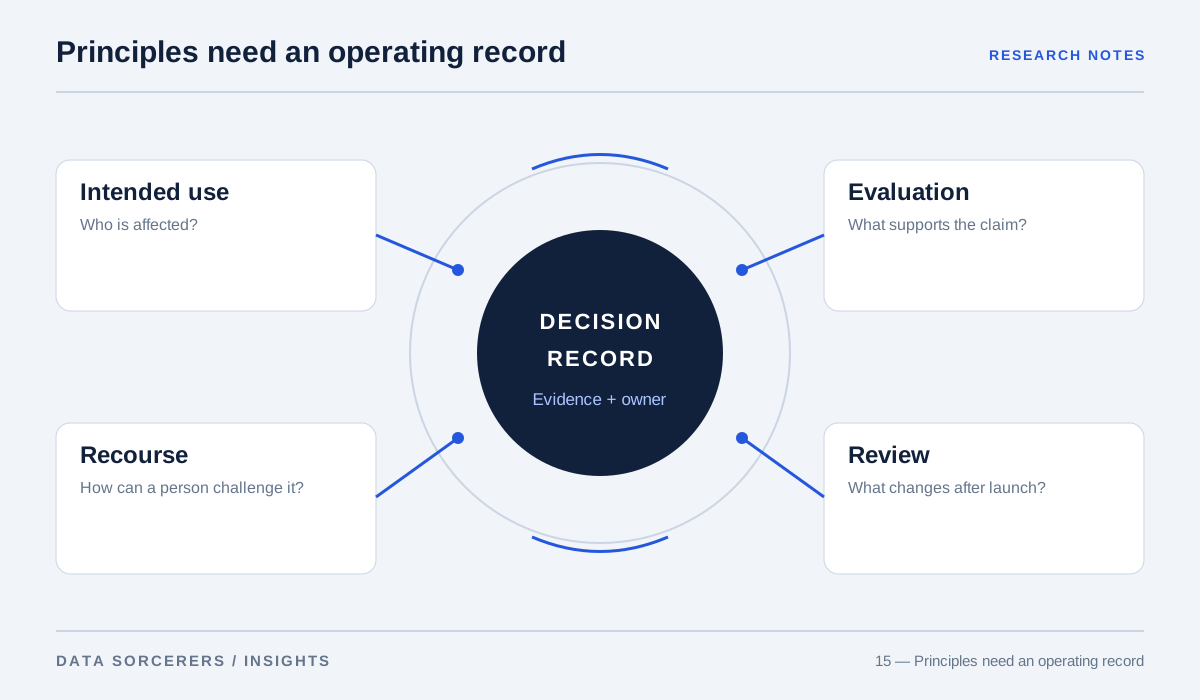
A release record can link the intended use, relevant risks, evaluation results, unresolved issues, and the person responsible for accepting or reducing those risks. Preserve the reasoning when a system is narrowed, delayed, or expanded. This allows a later reviewer to understand what was known at the time. A decision log should remain usable; collecting hundreds of disconnected artifacts can obscure responsibility as effectively as documenting nothing.
A review gate needs a falsifiable condition
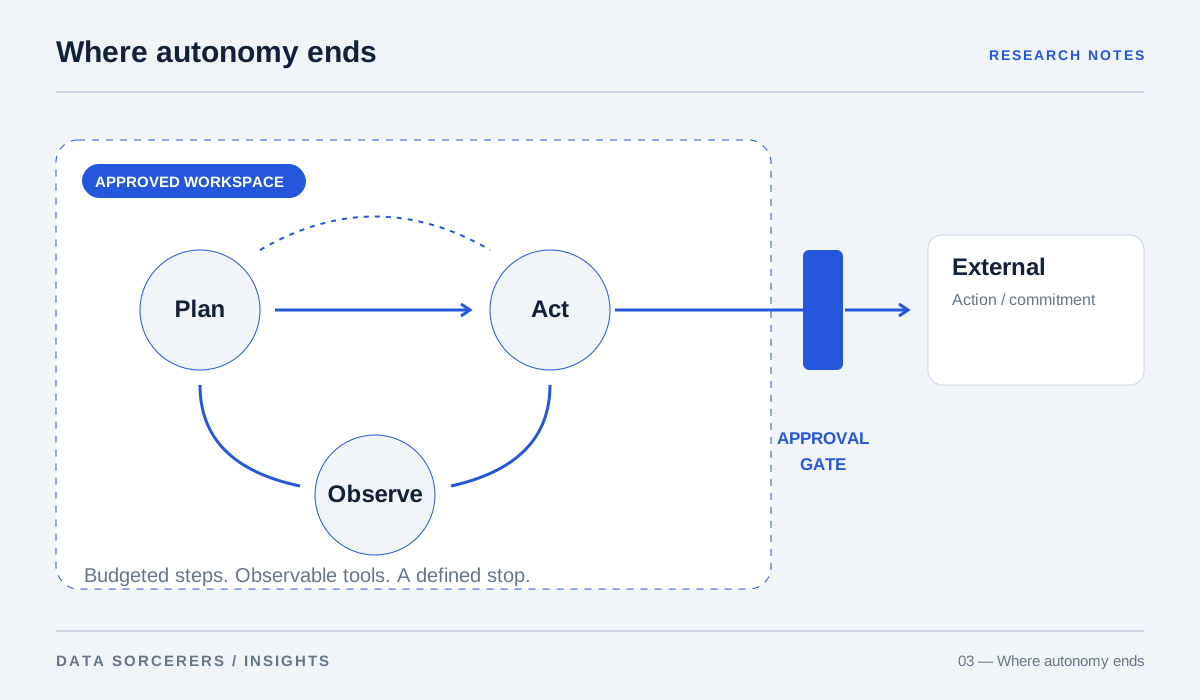
“Human oversight is available” is difficult to evaluate until the product defines what the person can observe and change. A more testable condition would specify that an authorized reviewer can inspect the supporting evidence, reject the recommendation, correct relevant information, and prevent the consequential action before it occurs. The exact condition depends on the workflow.
This proposal connects auditing across the lifecycle with human-AI interaction design. 510 Test it under realistic workload and with intentionally incorrect recommendations. Record whether the reviewer detects the problem and whether the system actually honors the intervention. A visible approval button can coexist with an ineffective process if the action has already happened or the evidence cannot be inspected. Governance becomes concrete when the claimed safeguard can fail a test—and when that failure changes the release decision.
Governance is tested when circumstances change
After deployment, users discover unexpected cases, data sources change, and new capabilities become available. A responsible operating model needs triggers for re-evaluation and a practical way to pause or narrow a feature. It also needs a route for affected people to report a problem without understanding the model’s architecture.
Our conclusion is that responsible AI is visible in ordinary decisions: what the system may access, which claims it makes, how uncertainty is presented, who can challenge an outcome, and what happens after an incident. The sources reviewed here supply frameworks and methods for those decisions; they do not remove the need for judgment. Governance becomes credible when an organization can show how a principle changed the product, what evidence supported the change, and who remains accountable for its consequences.
Make each important AI principle visible in a product decision, an evaluation, and an accountable owner.
Sources & methodology
This editorial synthesizes primary research, technical standards, and original engineering documentation. It is not an original experimental study or a systematic literature review. Research findings apply to the conditions studied; product recommendations are our interpretation. Figures explain concepts and do not present experimental measurements.
Sources checked on 31 October 2026. Publication dates and preprint versions may differ; the linked record identifies the referenced work. To suggest a correction, email contact@data-sorcerers.com.
- NIST (2023) — AI Risk Management Framework ↗Back to text ↑
- NIST (2024) — AI 600-1: Generative Artificial Intelligence Profile ↗Back to text ↑
- Mitchell et al. (2019) — Model Cards for Model Reporting ↗Back to text ↑
- Gebru et al. (2021) — Datasheets for Datasets ↗Back to text ↑
- Raji et al. (2020) — Closing the AI Accountability Gap: Defining an End-to-End Framework for Internal Algorithmic Auditing ↗Back to text ↑
- Hardt, Price and Srebro (2016) — Equality of Opportunity in Supervised Learning ↗Back to text ↑
- Selbst et al. (2019) — Fairness and Abstraction in Sociotechnical Systems ↗Back to text ↑
- Barocas, Hardt and Narayanan — Fairness and Machine Learning: Limitations and Opportunities ↗Back to text ↑
- NIST (2021) — Four Principles of Explainable Artificial Intelligence ↗Back to text ↑
- Amershi et al. (2019) — Guidelines for Human-AI Interaction ↗Back to text ↑